 |
| The volunteers, Jane, me, Richard and Michael |
The volunteers had finished cleaning all 8,750 books the week before - a huge achievement - and we wanted to show them our appreciation for all their hard work, and our affection for them as colleagues over the 2+ years it had taken them to clean all the books.
Up to 1200 person hours have been clocked up by the volunteers, assuming the maximum of 5 volunteers are cleaning at any one time. They have completed 96 morning sessions of an average of 2.5 hours per session. This amounts to an impressive 160 working days’ worth of cleaning!
The celebration
Our impressive VIP guest list comprised:
The NADFAS Heritage Volunteers (Audrey Osborne, Diane Heard, Pam Lakin, Sue Frankland, Wendy Walford);
Clair Castle (Librarian) and Jane Acred (Assistant Librarian);
The Head of the Department of Zoology (Prof. Michael Akam);
The Departmental Administrator (Julian Jacobs);
The Academic Librarian (Dr Richard Preece);
The Heritage Volunteers Representatives Coordinator for
NADFAS East Anglia (Prof. Mark Tatham, plus his wife);
Pam Marcuson, the Vice
Chairman of the Cambridge branch of NADFAS (CAMdfas).
We also invited the volunteers to
bring a friend or relative who may have been interested in seeing what they’ve been up
to here over the last couple of years!
 |
| Guests mingling. |

 |
| I was VERY nervous about the presence of food and drink in the library for the first time ever, probably. But everyone was very well behaved except for me, who managed to knock over and shatter a (thankfully empty) glass! |
 |
| Me, Wendy and Tarun (postgraduate student rep on the Library Committee). |
There was some sparkly wine and soft drinks and nibbles inside the main entrance to the library, then we had a few brief presentations.
 |
| Richard pours the prosecco! |
 | |||||
| Michael said some very kind words about the history of the project, some facts and figures, and the impact the project has had on the rare books. We must continue to look after them. |
 |
| My speech mainly consisted of thanks for all the people who have supported and been involved in the project. |
 |
| We presented some books to the volunteers to thank them, and to remind them of us! |
 |
| We gave each volunteer a copy of this amazing book. the Art of Nature by Judith Magee. It talks about and has many illustrations of books that the Natural History Museum owns but which we also own copies of (and which the volunteers will have cleaned!), across a range of subjects in nature. We tied the book in true volunteer style! |
 |
| Wendy had some very inspiring words about being privileged to handle the books that represent so much human endeavor. |
 |
| The volunteers very generously presented Jane and I with presents too - mugs with lovely birds on them! |
We had some rare books on display in another area of the library so that everyone could admire the volunteers’ handiwork. We also had a 'rare books open day' later on that day for all members of the Department following the presentation, giving them an opportunity to see some examples from the amazing collections that we own http://www.zoo.cam.ac.uk/library/special.html.This proved to be hugely popular: the session was only supposed to last for an hour but people were still coming in two hours later! It was great to show the books off to people who haven't yet been able to get a place on our regular 'behind the scenes' tours.
 |
| Books on show date from the 15th to 20th centuries! |
 |
| Me and some of the volunteers looking at Gessner's Historiam animalium, from 1555. |
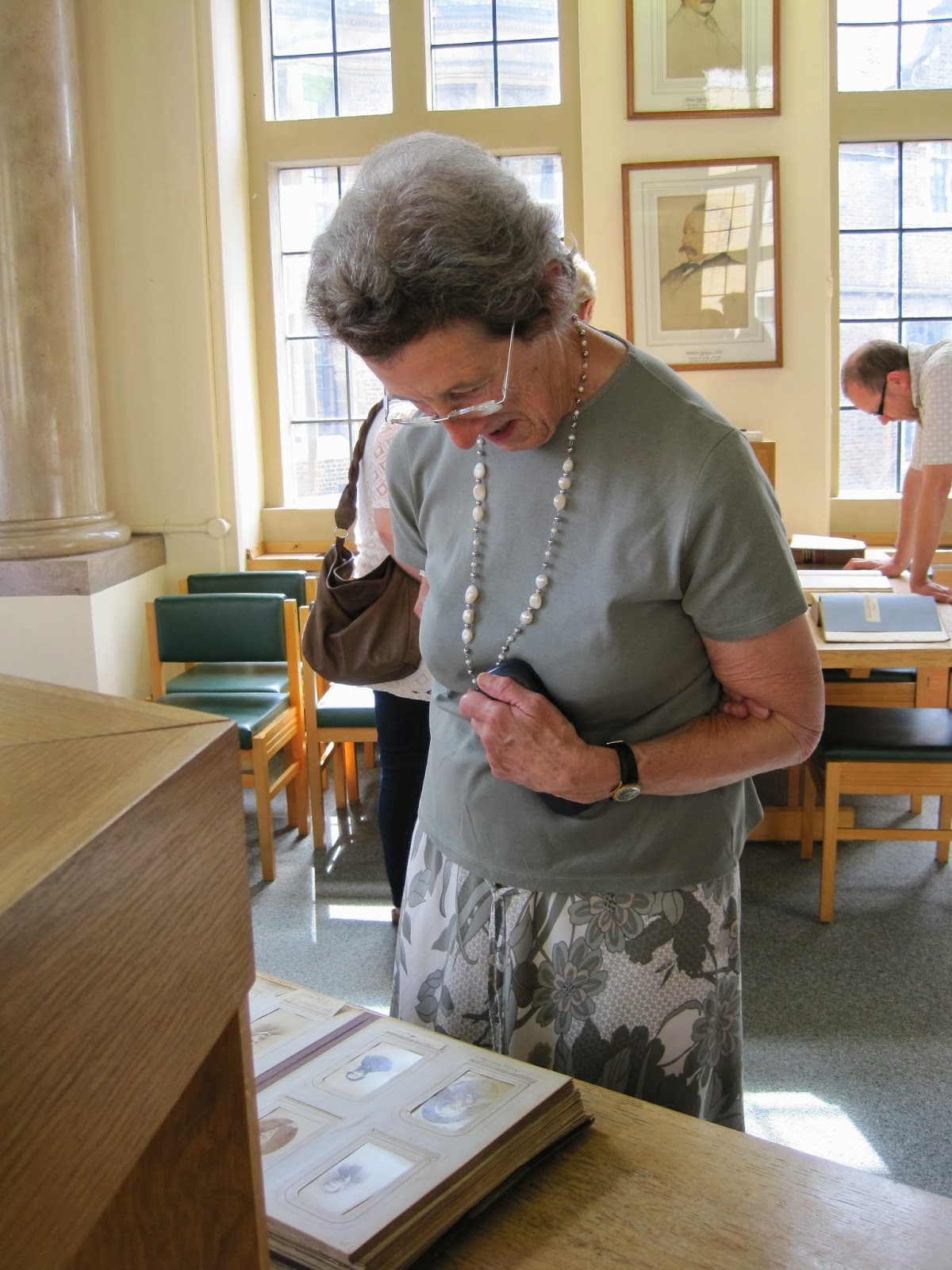 |
| Audrey looking at some of the photo albums of 'cartes de visites' that we believe Professor Alfred Newton, one of the main founders of the library, compiled. |
 |
| Richard and Julian looking at our copy of Linnaeus' Systema naturae, 1st edition, published in 1735. |
 |
| Pam looking at Ray and Willughby's Ornithologia libris tres, published in 1676. |
 |
| The volunteers' tools of the trade! |
Thanks
I would like to thank Julian and Michael for supporting this project financially, and Richard and the Library Committee for their support and enthusiasm for the project.
I would like
to thank Beverley Donaldson, former Administrator at the Museum of Zoology, for
her invaluable help in my getting the volunteer policy together and for her
sound advice.
I would also
like to thank Jane for participating so fully in the project; often setting up
for me before the volunteers arrived if I was too busy, and for supervising the
volunteers when I wasn’t available, and clearing up afterwards. I hope she has
enjoyed this!
Thank you to Paula McPhee for arranging the refreshments for the celebration and for being our official photographer on the day.
Thank you to Paula McPhee for arranging the refreshments for the celebration and for being our official photographer on the day.
This project
has really expanded our knowledge about rare books, their construction,
conservation and preservation. Because the books have been conserved I have been
able to give behind the scenes tours of the rare books for members of the
Department; they are so excited to see the books and are amazed to learn about
how they have been cleaned just using brushes!
I have also
enjoyed writing blog posts about the volunteers’ progress and some of the weird
and wonderful books they brought to my attention; my favourite was the book
about warblers and the ‘problems of their lives’ which featured some rather melancholy
looking blackcaps! They also discovered the amazing double-page spread in
Gould’s Birds of Australia. And I
think we all learned a thing or two about how to tie books correctly, which
appears to correlate with how we tie our shoelaces!
Finally of course I would like to thank all of the volunteers; Audrey, Diane, Pam, Sue and especially their coordinator Wendy for their dedication to this project. You have helped us raise the profile of the special collections enormously. Jane and I have really enjoyed working with you all and we will especially miss the sound of laughter coming from the Newton Room!
 |
| The amazing double-page spread of plates in Gould's Birds of Australia, 1848, that the volunteers brought to our attention. |
Finally of course I would like to thank all of the volunteers; Audrey, Diane, Pam, Sue and especially their coordinator Wendy for their dedication to this project. You have helped us raise the profile of the special collections enormously. Jane and I have really enjoyed working with you all and we will especially miss the sound of laughter coming from the Newton Room!
Cleaning, and conserving and preserving the books in these ways has preserved them for significantly longer for future generations to enjoy.
You can find out much more about this project here: http://www.balfourlibrary.blogspot.co.uk/search/label/cleaning.


