The Wellcome Trust will be bringing the papers of the pioneers of modern genetics together in one place for the first time as part of their digitization project 'Modern Genetics and its Foundations'.
Tens of thousands of notes, letters, sketches, lectures, photographs and
essays, produced by the key players in the discovery of the structure
of DNA and the development of genetics will be freely
available online.They include the papers of Francis Crick, James D
Watson, Rosalind Franklin and Maurice Wilkins.
The Wellcome Trust will be collaborating with the Cold Spring Harbor Laboratory, The Churchill Archives Centre, the University of Glasgow, King's College London and UCL (University College London) to make their archival collections available.
Find out more about exactly which material will be made available by reading the the press release here: http://www.wellcome.ac.uk/News/Media-office/Press-releases/2012/WTVM055104.htm
Thursday, 31 May 2012
10 websites to help you keep up to date with scholarly journal articles
Check out this blog post for information on 10 websites to help you keep up to date with current scientific literature.
They include SciFeeds, tic-TOCs, Cite U Like, MyJournals.org, Zetoc, My Favourite Journals.
Click here to go to the blogpost: http://hwlibrary.wordpress.com/2009/10/21/10-websites-to-help-you-keep-up-to-date-with-scholarly-journal-contents/
They include SciFeeds, tic-TOCs, Cite U Like, MyJournals.org, Zetoc, My Favourite Journals.
Click here to go to the blogpost: http://hwlibrary.wordpress.com/2009/10/21/10-websites-to-help-you-keep-up-to-date-with-scholarly-journal-contents/
Labels:
e-resources
Friday, 18 May 2012
SPIE Digital Library trial access until 14th June
Trial access has been set up to the SPIE Digital Library by
the Journal Co-ordination Scheme (in conjunction with ebooks@cambridge) and
will run until 14th June 2012.
The SPIE Digital Library includes more than 310,000
conference proceedings, peer-reviewed journal articles and eBooks from the
areas of astronomy, biophotonics, nanotechnology, sensors, lasers,
electro-optics, communications, imaging, and more. SPIE is a not-for-profit
educational society with over 17,000 Members worldwide.
Journals:
The journals are available in the ejournals@cambridge A-Z http://camsfx.hosted.exlibrisgroup.com/cambridge/az
listing
- Proceedings of SPIE
- Optical Engineering
- Journal of Electronic Imaging
- Journal of Biomedical Optics
- Journal of Micro/Nanolithography, MEMS, and MOEMS
- Journal of Applied Remote Sensing
- Journal of Nanophotonics
- Journal of Photonics for Energy
- SPIE Reviews
- SPIE Letters Virtual Journal
eBooks:
There are currently 164 ebooks from 1989 to present
available as an add-on (with an additional cost) to the SPIE Digital Library.
The ebooks include titles from the SPIE Press series in optics and photonics:
·
SPIE Press Monographs are authoritative reference
books, textbooks, and handbooks.
·
Tutorial Texts cover fundamental and emerging
topics at introductory and intermediate levels.
·
Field Guides present key information that
students and practicing engineers and scientists need in a concise
format.
A user guide http://spie.org/Documents/Publications/Digital%20Library/DL-User-Guide-2011.pdf
with information about the SPIE Digital Library and tips on how to search the
site is available. It also shows how to set-up RSS feeds and utilize
bibliographic, bookmarking, and research tools.
This trial is available both on and off campus. Off campus
access is available via Raven logins, but for off campus access, users should
use the links above, the Off campus access bookmarklet http://www.lib.cam.ac.uk/toolbox/bookmarklet.html
or the ejournals@cambridge A-Z http://camsfx.hosted.exlibrisgroup.com/cambridge/az
listing for journals. Shibboleth access (Institutional login) is being set up
but is not yet available.
Please send all feedback on this trial resource to ejournals@lib.cam.ac.uk by 16th June
2012.
Labels:
e-resources
Monday, 7 May 2012
Wellcome Trust joins 'academic spring' to open up science - Guardian article
This interesting article from the Guardian http://www.guardian.co.uk/science/2012/apr/09/wellcome-trust-academic-spring?INTCMP=SRCH discusses how the Wellcome Trust is supporting the growing 'academic spring' campaign to allow all research papers to be shared online.
Nearly 9,000 researchers have now apparently signed up to boycott journals that restrict access to research papers (i.e. those published by Elsevier). The Wellcome Trust itself is about to launch a "'high calibre scientific journal called eLife that would compete directly with top-tier publications such as Nature and Science".
These are interesting times in the world of academic publishing. There will inevitably be consequences for academic libraries across the world. British universities currently spend £200m a year on journal subscriptions, which represents around 10% of the block grants that they receive from government, as outlined in this article.
Labels:
science news
Tuesday, 1 May 2012
Why do old books smell?
Readers in this library have said in past surveys that they either love or hate the 'smell of musty old books' in the library.
What do you think? I personally like it but am in fact now immune to the smell here now! It's nice when people come in and say how much they like it too.
Here's an article all about the science of why old books smell. It's all to do with volatile organic compounds, apparently:
http://www.guardian.co.uk/science/grrlscientist/2012/may/01/1
Wednesday, 18 April 2012
Rare book now on display in the Library
I have just put a different book in the glass display cabinet - please come and have a look at this amazing work!
The
rare book on display from our collection is: Hooke, Robert. Micrographia restaurata: or, the copper-plates of Dr. Hooke's wonderful
discoveries by the microscope, reprinted and fully explained. Whereby the most
valuable particulars in that celebrated author's Micrographia are brought
together in a narrow compass and intermixed, occasionally, with many
entertaining and instructive discoveries and observations in natural history.
London: John Bowles; 1765.
Balfour Library class
mark: Folio
101.
The book is open at: Plate 26, The
great-bellyed, or female Gnat. This is a spectacular copperplate engraving
depicting a gnat under the microscope. All of the plates in this work gave
readers an amazing insight into the miniature world of animals for perhaps the
first time.
Robert Hooke (1635-1703) was an
English instrument-maker, experimentalist and natural philosopher. In 1653 or
1654 he went to Christ Church, Oxford, initially as a chorister, but then
serving as assistant to Robert Boyle. Hooke assisted Boyle with his experiments
on the spring and the weight of air and was thus exposed to active scientific
research.
In 1662 Hooke was working as curator
for experiments for the newly formed Royal Society of London, his task being to
provide three or four experiments at each meeting. Hooke published the
demonstrations and commentaries he gave at these meetings in works such as the Micrographia,
or, Some physiological descriptions of minute bodies made by magnifying
glasses, with observations and inquiries thereupon (1665). This book
initiated the field of microscopy; Hooke applied his microscope to inanimate
and animate objects, revealing remarkable features about their structure. His
talent for drawing and attention to detail is evident in the many plates
included in the volume, especially those of the fly, gnat and flea, and his
text provides clear and precise descriptions of observations, and also
explanations of the things observed.
Many of the observations he recorded
in Micrographia were new. For example in his observation on the
structure of cork he became the first scientist to describe cells (he coined
that term because plant cells, which are walled, reminded him of monks’
chambers), and he was the first to describe the compound eye of the fly.
Forty years after Hooke’s death, Micrographia
had become difficult and expensive to obtain. The Micrographia was
reissued in 1745 in a condensed form. This version, Micrographia Restaurata
(Micrographia Restored) contains all of Hooke’s original engravings,
most of which were printed from the original copper plates. The commentary is
shorter and simpler than the original, but preserves the important features of
Hooke’s original observations.
Sources:
King’s College London, Special
Collections, Hooke’s Micrographia http://www.kingscollections.org/exhibitions/specialcollections/to-scrutinize-nature/boyle-and-hooke/hookes-micrographia
Patri J. Pugliese, ‘Hooke, Robert (1635–1703)’,
Oxford Dictionary of National Biography, Oxford University Press, 2004 [http://www.oxforddnb.com/view/article/13693,
accessed 18 April 2012]
Rod Beavan at http://www.roberthooke.org.uk/
Sutton, John (Apr 2001) Hooke, Robert.
In: eLS. John Wiley & Sons Ltd, Chichester. http://www.els.net
[doi: 10.1038/npg.els.0002424]
Thursday, 12 April 2012
New acquisitions
New books purchased
Comparative hearing in insects, edited by Ronald R. Hoy, Arthur N. Popper, Richard R. Fay. New York, NY: Springer-Verlag; 1998 Balfour Library shelfmark: Q.5 (78ii).
The evolution of sibling rivalry, by Douglas W. Mock and Geoffrey A. Parker. Oxford: Oxford University Press; 1997. Balfour Library shelfmark: GFU (340i-iii) (2 copies on the Overnight Loan shelves, 1 copy on the Open Shelves).
Farmland birds across the world, edited by Wouter van den Weijden, Paul Terwan, and Adriaan Guldemond. Barcelona: Lynx Edicions; 2010. Balfour Library shelfmark: qK.8 (5) (Quarto, large sized shelves).
Foraging behavior and ecology, edited by David W. Stephens, Joel S. Brown, and Ronald C. Ydenberg. Chicago, IL: London: The university of Chicago Press; 2007. Balfour Library shelfmark:GFU (339i-ii).
How humans evolved, 6th ed., by Robert Boyd, Jean B. Silk. New York, NY: W. W. Norton & Company; 2012. Balfour Library shelfmark: EO (278fi-ii) (Overnight Loan shelves).
An introduction to behavioural ecology, 4th ed., by Nicholas B. Davies, John R. Krebs and Stuart A. West. Chichester: John Wiley & Sons, Ltd.; 2012. Balfour Library shelfmark: GFU (138di-v) (4 copies on the Overnight Loan shelves, 1 copy on the Open Shelves).
Making sense of evolution: the conceptual foundations of evolutionary biology, by Massimo Pigliucci and Jonathan Kaplan. Chicago, IL: London: The University of Chicago Press; 2006. Balfour Library shelfmark: EO (334).
Statistical theory and methods for evolutionary genomics, by Xun Gu. Oxford: Oxford University Press; 2011. Balfour Library shelfmark: EN (186).
Statistics: an introduction using R, by Michael J. Crawley. Chichester: John Wiley & Sons, Ltd.; 2005. Balfour Library shelfmark: EBB (80ii-iii).
Donations
The egg collectors of Great Britain & Ireland: a compilation of profiles of some 20th century egg collectors, by Andrew C. Cole and William M. Trobe. Leeds: Peregrine Books; 2000. Balfour Library shelfmark: K.9 (25a).
The egg collectors of Great Britain & Ireland. An update: a compilation of information additional to the original book published in 2000, by Andrew C. Cole and William M. Trobe. Leeds: Peregrine Books; 2011. Balfour Library shelfmark: K.9 (25b).
Riddle of the feathered dragons: hidden birds of China, by Alan Feduccia. New Haven, CT: London: Yale University Press; 2012. Balfour Library shelfmark: K.12 (6).
Donations from Cambridge University Press
Evolutionary history of bats: fossils, molecules and morphology, edited by Gregg F. Gunnell and Nancy B. Simmons. Cambridge: Cambridge University Press; 2012. Balfour Library shelfmark: YV (15).
Theses
Extraterritorial prospecting and territory defence in cooperatively breeding meerkats, by Rafael Mares. Cambridge; 2012. Balfour Library shelfmark: Thesis (513). (Library Office).
Propagation for the conservation and applied use of freshwater mussels, by Holly Barclay. Cambridge; 2010. Balfour Library shelfmark: Thesis (512). (Library Office).
Structure and function of the regulatory regions of pannier, a gene involved in the bristle patterning of Drosophilidae, by Richard Wallbank. Cambridge; 2011. Balfour Library shelfmark: Thesis (511). (Library Office).
Wednesday, 28 March 2012
Christopher Webb Smith special collection
As described on the Balfour Library website at http://www.zoo.cam.ac.uk/library/webbsmith.html we own well over 500 magnificent original water colour paintings of African and Indian
birds and scenes by Christopher Webb Smith (1796-1871). They were presented to
the Museum of Zoology by Mrs. Frances H. Atkinson, the wife of the Master of
Clare College, in March 1903.
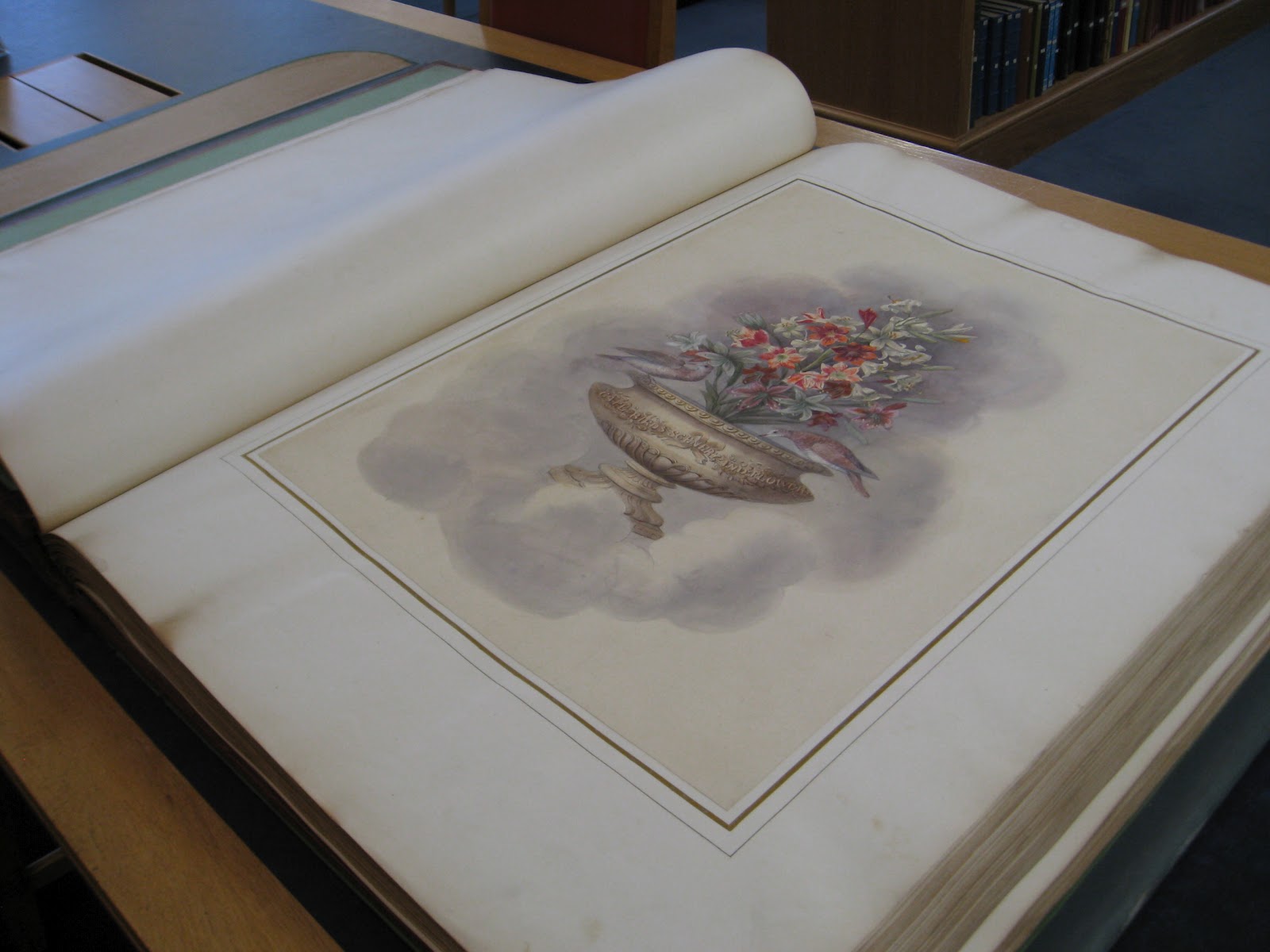
A few weeks ago I finally got to see one of the bound volumes of the Webb Smith paintings which is stored at the University Library because it is absolutely huge (elephant folio size or larger) and we do not have space, or the proper environmental conditions for it in the Balfour Library.
Cape birds, flowers and scenery was produced between 1839 and 1859. It consists of 56 original water colours mostly signed and dated by Webb Smith.
The title page itself is very impressive with beautiful colours and detail.
One of my favourites depicts woodpeckers chasing insects on a tree.
When you look closely you can see the fine pencil drawings beneath the paint.
This is my absolute favourite because I love kingfishers and it shows the Indian background scenery better - see how the water colours are so vibrant, they leap off the page.
I had a great time photographing these - they certainly attracted a lot of attention in the Manuscripts Reading Room! We are extremely lucky to own such magnificent items.
A few weeks ago I finally got to see one of the bound volumes of the Webb Smith paintings which is stored at the University Library because it is absolutely huge (elephant folio size or larger) and we do not have space, or the proper environmental conditions for it in the Balfour Library.
Cape birds, flowers and scenery was produced between 1839 and 1859. It consists of 56 original water colours mostly signed and dated by Webb Smith.
| The pencil was added to give some idea of the scale of the book. It measures around 70cm tall! |
| Bookplate. Most of the books originally donated to the Museum were moved into the Library at a later date. |
The title page itself is very impressive with beautiful colours and detail.
| Cape birds, flowers and scenery is written on the urn. |
One of my favourites depicts woodpeckers chasing insects on a tree.
| Complete painting. |
| Close up up of the birds. |
This is my absolute favourite because I love kingfishers and it shows the Indian background scenery better - see how the water colours are so vibrant, they leap off the page.
| Complete painting. |
| Close up of the birds. |
| I think the whites have been done very skillfully and beautifully. |
Monday, 12 March 2012
End of Lent Term 2012 information
Lent Term 2012 ends on Friday 16th
March. All books on loan from the Balfour Library must be returned by this
date, or can be renewed for further periods unless they have been requested by another
reader. Saturday morning opening has now finished until next term.
Vacation borrowing for undergraduates
This is permitted for the whole of the Easter vacation.
This means that you will be able to take a maximum of two books away from Cambridge which must be returned by midnight on the first day of the Easter Term (24 th April 2012). This applies to Overnight Loan books and Open Shelf books.
You can borrow books for the
vacation period from 8:45am on Friday 16th March. This is on a
strictly first-come, first served basis. You may not reserve books before
borrowing them.
Please see the library website at: http://www.zoo.cam.ac.uk/library/booksborrow.html for more information on how to borrow,
return and renew books on loan from the Balfour Library.
You may be interested to know that the
University Library and the Central Science Library (on this site) also offer
vacation borrowing for undergraduates. See the UL website for more details at: http://www.lib.cam.ac.uk/students/vacationborrowing.html
How to access online resources when you are away from Cambridge
The recommended route for accessing ejournals provided by the University remotely is as follows:
How to access online resources when you are away from Cambridge
The recommended route for accessing ejournals provided by the University remotely is as follows:
- Go to the ejournals@cambridge website at: http://camsfx.hosted.exlibrisgroup.com/cambridge/az
- Enter the title of the journal you need (if it does not appear then there is no online subscription to it)
- Click on the 'find journals by title' button
- Click on the link for the journal title as appropriate for the particular year of publication of the article that you need
- The Raven login box should appear
- Enter your Raven userid and password and click on the 'Submit' button
- You should then be taken to the host page for that journal and you can find the article(s) you need from there
- (You only need to enter the Raven login once per session so you won't have to keep logging in and out each time you need a different journal)
Away from Cambridge, you will not be able to
get the full text of ejournal articles through searching PubMed or Google /
GoogleScholar, or directly from the journal's homepage for example, as you will
not be recognised as being a valid member of the University of Cambridge and
will not be allowed to download them. The recommended route as above should
guarantee you the access to the content you are entitled to.
It is strongly recommended that you check the ejournals@cambridge website as above to see whether you will actually be able to access particular online journals remotely BEFORE you leave Cambridge. See also the eresources@cambridge website at: http://www.lib.cam.ac.uk/electronicresources/ for access to particular databases, such as Scopus and Web of Knowledge. See the 'Access Route' link next to the journal or database title to check this. Some online journals are not accessible outside of the University network so you may wish to download or print off articles from these before you leave Cambridge.
Raven passwords
If you do not currently have a Raven password and think you may need one to access the Web of Knowledge or Scopus databases (to search scientific literature) or online journals and databases when you are away from Cambridge, you should apply for one following the instructions given on the University Computing Service 'How do I get a Raven password?' website at: http://www.cam.ac.uk/cs/docs/faq/n5.html This page will also help you if you have lost your Raven password.
Troubleshooting ejournals access
Finally, if you are having trouble accessing ejournals and eresources remotely using your Raven password please see the guidance provided on the Central Science Library's 'Raven FAQs' website at: http://www.lib.cam.ac.uk/CSL/ravenqanda.htm
Easter period closing dates
The Balfour Library will close for Easter at 5:00pm on Thursday 5th April and will re-open at 8:30am on Tuesday 10th April. The library will be open as usual throughout the Easter Vacation however, see our opening hours at http://www.zoo.cam.ac.uk/library/open.html
We wish you a very Happy Easter!
Clair and Jane
Wednesday, 7 March 2012
Nature Climate Change journal now available
Nature Climate Change
http://www.nature.com/nclimate/about/index.html
has been added to the Journals Coordination Scheme's Nature Platinum
subscription for 2012.
Access to this title will shortly be available in
LibrarySearch http://search.lib.cam.ac.uk/
and ejournals@cambridge http://camsfx.hosted.exlibrisgroup.com/cambridge/az
Labels:
e-resources
Subscribe to:
Posts (Atom)