Thursday, 31 May 2012

Balfour Library Conservation Project - article published in volunteer newsletter


Our wonderful team of five NADFAS (National Association of Decorative & Fine Arts Societies) Heritage Volunteers has been cleaning our rare books since July last year. I have written an article all about the project and the progress made so far (with pictures!) for the NADFAS Review Volunteer Supplement which was published on 25th May. 

I have posted the article on our special collections website: http://www.zoo.cam.ac.uk/library/special.html#clean

See here for further details of the project http://www.balfourlibrary.blogspot.co.uk/2011/07/book-cleaning-project-in-library.html (you can also click on the ‘cleaning’ label further down on the right hand side of the blog to see additional blog posts relating only to this project).

The current team will hopefully continue to work throughout the Summer Vacation 2012. They are starting again next Thursday 7th June following a break during the Easter Term.


Subscription to Birds of North America (BNA) Online renewed for another 3 years!


We are very pleased to announce that the Balfour Library has just renewed the subscription to BNA Online for another 3 years, until June 2015. 

This has proved to be a very popular resource over the last three years and we are glad to be able to subscribe to it for a further three years.

Published by the Cornell Lab of Ornithology and the American Ornithologists' Union, the resource provides comprehensive life histories for each of the 716+ species of birds breeding in the USA (including Hawaii) and Canada.You can search for species by common or scientific name, and you can browse these. Account contents are frequently updated, with contributions from researchers, citizen scientists, and designated reviewers and editors. There are image and video galleries showing plumages, behaviors, habitat, nests and eggs, and more. Most accounts now feature recordings of the songs and calls of their species, selected from the extensive collection of Cornell's Macaulay Library http://macaulaylibrary.org/ 

Access is available throughout the University of Cambridge and off-campus. When on the university network you should be able to go to the BNA Online website at http://bna.birds.cornell.edu/bna/ and access it directly from there. However if you are 'off-campus' you will need to go to the eresources@cambridge website http://www.lib.cam.ac.uk/eresources/index.php (click on the Databases tab and search for it there) and you will be prompted for your Raven password.

We hope you continue to enjoy using this resource.

Wellcome Trust digitizing the papers of the pioneers of modern genetics

The Wellcome Trust will be bringing the papers of the pioneers of modern genetics together in one place for the first time as part of their digitization project 'Modern Genetics and its Foundations'.

Tens of thousands of notes, letters, sketches, lectures, photographs and essays, produced by the key players in the discovery of the structure of DNA and the development of genetics will be freely available online.They include the papers of Francis Crick, James D Watson, Rosalind Franklin and Maurice Wilkins.

The Wellcome Trust will be collaborating with the Cold Spring Harbor Laboratory, The Churchill Archives Centre, the University of Glasgow, King's College London and UCL (University College London) to make their archival collections available.

Find out more about exactly which material will be made available by reading the the press release here: http://www.wellcome.ac.uk/News/Media-office/Press-releases/2012/WTVM055104.htm

10 websites to help you keep up to date with scholarly journal articles

Check out this blog post for information on 10 websites to help you keep up to date with current scientific literature.

They include SciFeeds, tic-TOCs, Cite U Like, MyJournals.org, Zetoc, My Favourite Journals.

Click here to go to the blogpost: http://hwlibrary.wordpress.com/2009/10/21/10-websites-to-help-you-keep-up-to-date-with-scholarly-journal-contents/

Friday, 18 May 2012

SPIE Digital Library trial access until 14th June


Trial access has been set up to the SPIE Digital Library by the Journal Co-ordination Scheme (in conjunction with ebooks@cambridge) and will run until 14th June 2012.

The SPIE Digital Library includes more than 310,000 conference proceedings, peer-reviewed journal articles and eBooks from the areas of astronomy, biophotonics, nanotechnology, sensors, lasers, electro-optics, communications, imaging, and more. SPIE is a not-for-profit educational society with over 17,000 Members worldwide.

Journals:

The journals are available in the ejournals@cambridge A-Z http://camsfx.hosted.exlibrisgroup.com/cambridge/az listing      

  • Proceedings of SPIE
  • Optical Engineering
  • Journal of Electronic Imaging
  • Journal of Biomedical Optics
  • Journal of Micro/Nanolithography, MEMS, and MOEMS
  • Journal of Applied Remote Sensing
  • Journal of Nanophotonics
  • Journal of Photonics for Energy
  • SPIE Reviews
  • SPIE Letters Virtual Journal
eBooks:

There are currently 164 ebooks  from 1989 to present available as an add-on (with an additional cost) to the SPIE Digital Library. The ebooks include titles from the SPIE Press series in optics and photonics:

·         SPIE Press Monographs are authoritative reference books, textbooks, and handbooks.
·         Tutorial Texts cover fundamental and emerging topics at introductory and intermediate levels.
·         Field Guides present key information that students and practicing  engineers and scientists need in a concise format.

A user guide http://spie.org/Documents/Publications/Digital%20Library/DL-User-Guide-2011.pdf with information about the SPIE Digital Library and tips on how to search the site is available. It also shows how to set-up RSS feeds and utilize bibliographic, bookmarking, and research tools.

This trial is available both on and off campus. Off campus access is available via Raven logins, but for off campus access, users should use the links above, the Off campus access bookmarklet http://www.lib.cam.ac.uk/toolbox/bookmarklet.html or the ejournals@cambridge A-Z http://camsfx.hosted.exlibrisgroup.com/cambridge/az listing for journals. Shibboleth access (Institutional login) is being set up but is not yet available.

Please send all feedback on this trial resource to ejournals@lib.cam.ac.uk by 16th June 2012.

Monday, 7 May 2012

Wellcome Trust joins 'academic spring' to open up science - Guardian article

This interesting article from the Guardian http://www.guardian.co.uk/science/2012/apr/09/wellcome-trust-academic-spring?INTCMP=SRCH discusses how the Wellcome Trust is supporting the growing 'academic spring' campaign to allow all research papers to be shared online.

Nearly 9,000 researchers have now apparently signed up to boycott journals that restrict access to research papers (i.e. those published by Elsevier). The Wellcome Trust itself is about to launch a "'high calibre scientific journal called eLife that would compete directly with top-tier publications such as Nature and Science".

These are interesting times in the world of academic publishing. There will inevitably be consequences for academic libraries across the world. British universities currently spend £200m a year on journal subscriptions, which represents around 10% of the block grants that they receive from government, as outlined in this article.

Tuesday, 1 May 2012

Why do old books smell?


Readers in this library have said in past surveys that they either love or hate the 'smell of musty old books' in the library.

What do you think? I personally like it but am in fact now immune to the smell here now! It's nice when people come in and say how much they like it too.

Here's an article all about the science of why old books smell. It's all to do with volatile organic compounds, apparently:

http://www.guardian.co.uk/science/grrlscientist/2012/may/01/1

Wednesday, 18 April 2012

Rare book now on display in the Library


I have just put a different book in the glass display cabinet - please come and have a look at this amazing work!

The rare book on display from our collection is: Hooke, Robert. Micrographia restaurata: or, the copper-plates of Dr. Hooke's wonderful discoveries by the microscope, reprinted and fully explained. Whereby the most valuable particulars in that celebrated author's Micrographia are brought together in a narrow compass and intermixed, occasionally, with many entertaining and instructive discoveries and observations in natural history. London: John Bowles; 1765.

Balfour Library class mark: Folio 101.

The book is open at: Plate 26, The great-bellyed, or female Gnat. This is a spectacular copperplate engraving depicting a gnat under the microscope. All of the plates in this work gave readers an amazing insight into the miniature world of animals for perhaps the first time.

Robert Hooke (1635-1703) was an English instrument-maker, experimentalist and natural philosopher. In 1653 or 1654 he went to Christ Church, Oxford, initially as a chorister, but then serving as assistant to Robert Boyle. Hooke assisted Boyle with his experiments on the spring and the weight of air and was thus exposed to active scientific research.

In 1662 Hooke was working as curator for experiments for the newly formed Royal Society of London, his task being to provide three or four experiments at each meeting. Hooke published the demonstrations and commentaries he gave at these meetings in works such as the Micrographia, or, Some physiological descriptions of minute bodies made by magnifying glasses, with observations and inquiries thereupon (1665). This book initiated the field of microscopy; Hooke applied his microscope to inanimate and animate objects, revealing remarkable features about their structure. His talent for drawing and attention to detail is evident in the many plates included in the volume, especially those of the fly, gnat and flea, and his text provides clear and precise descriptions of observations, and also explanations of the things observed.

Many of the observations he recorded in Micrographia were new. For example in his observation on the structure of cork he became the first scientist to describe cells (he coined that term because plant cells, which are walled, reminded him of monks’ chambers), and he was the first to describe the compound eye of the fly.

Forty years after Hooke’s death, Micrographia had become difficult and expensive to obtain. The Micrographia was reissued in 1745 in a condensed form. This version, Micrographia Restaurata (Micrographia Restored) contains all of Hooke’s original engravings, most of which were printed from the original copper plates. The commentary is shorter and simpler than the original, but preserves the important features of Hooke’s original observations.

Sources:


Patri J. Pugliese, ‘Hooke, Robert (1635–1703)’, Oxford Dictionary of National Biography, Oxford University Press, 2004 [http://www.oxforddnb.com/view/article/13693, accessed 18 April 2012]


Sutton, John (Apr 2001) Hooke, Robert. In: eLS. John Wiley & Sons Ltd, Chichester. http://www.els.net [doi: 10.1038/npg.els.0002424]

Thursday, 12 April 2012

New acquisitions

New books purchased 

Comparative hearing in insects, edited by Ronald R. Hoy, Arthur N. Popper, Richard R. Fay. New York, NY: Springer-Verlag; 1998 Balfour Library shelfmark: Q.5 (78ii).

The evolution of sibling rivalry, by Douglas W. Mock and Geoffrey A. Parker. Oxford: Oxford University Press; 1997. Balfour Library shelfmark: GFU (340i-iii) (2  copies on the Overnight Loan shelves, 1 copy on the Open Shelves).

Farmland birds across the world, edited by Wouter van den Weijden, Paul Terwan, and Adriaan Guldemond. Barcelona: Lynx Edicions; 2010. Balfour Library shelfmark: qK.8 (5) (Quarto, large sized shelves).

Foraging behavior and ecology, edited by David W. Stephens, Joel S. Brown, and Ronald C. Ydenberg. Chicago, IL: London: The university of Chicago Press; 2007. Balfour Library shelfmark:GFU (339i-ii).

How humans evolved, 6th ed., by Robert Boyd, Jean B. Silk. New York, NY: W. W. Norton & Company; 2012. Balfour Library shelfmark: EO (278fi-ii) (Overnight Loan shelves).

An introduction to behavioural ecology, 4th ed., by Nicholas B. Davies, John R. Krebs and Stuart A. West. Chichester: John Wiley & Sons, Ltd.; 2012. Balfour Library shelfmark: GFU (138di-v) (4 copies on the Overnight Loan shelves, 1 copy on the Open Shelves).

Making sense of evolution: the conceptual foundations of evolutionary biology, by Massimo Pigliucci and Jonathan Kaplan. Chicago, IL: London: The University of Chicago Press; 2006. Balfour Library shelfmark: EO (334).

Statistical theory and methods for evolutionary genomics, by Xun Gu. Oxford: Oxford University Press; 2011.  Balfour Library shelfmark: EN (186).

Statistics: an introduction using R, by Michael J. Crawley. Chichester: John Wiley & Sons, Ltd.; 2005. Balfour Library shelfmark: EBB (80ii-iii).

Donations

The egg collectors of Great Britain & Ireland: a compilation of profiles of some 20th century egg collectors, by Andrew C. Cole and William M. Trobe. Leeds: Peregrine Books; 2000. Balfour Library shelfmark: K.9 (25a).

The egg collectors of Great Britain & Ireland. An update: a compilation of information additional to the original book published in 2000, by Andrew C. Cole and William M. Trobe. Leeds: Peregrine Books; 2011. Balfour Library shelfmark: K.9 (25b).

Riddle of the feathered dragons: hidden birds of China, by Alan Feduccia. New Haven, CT: London: Yale University Press; 2012.  Balfour Library shelfmark: K.12 (6).

Donations from Cambridge University Press

Evolutionary history of bats: fossils, molecules and morphology, edited by Gregg F. Gunnell and Nancy B. Simmons. Cambridge: Cambridge University Press; 2012. Balfour Library shelfmark: YV (15). 

Theses

Extraterritorial prospecting and territory defence in cooperatively breeding meerkats, by Rafael Mares. Cambridge; 2012. Balfour Library shelfmark: Thesis (513). (Library Office).

Propagation for the conservation and applied use of freshwater mussels, by Holly Barclay. Cambridge; 2010. Balfour Library shelfmark: Thesis (512). (Library Office).

Structure and function of the regulatory regions of pannier, a gene involved in the bristle patterning of Drosophilidae, by Richard Wallbank. Cambridge; 2011. Balfour Library shelfmark: Thesis (511). (Library Office).

Wednesday, 28 March 2012

Christopher Webb Smith special collection

As described on the Balfour Library website at http://www.zoo.cam.ac.uk/library/webbsmith.html we own well over 500 magnificent original water colour paintings of African and Indian birds and scenes by Christopher Webb Smith (1796-1871). They were presented to the Museum of Zoology by Mrs. Frances H. Atkinson, the wife of the Master of Clare College, in March 1903. 

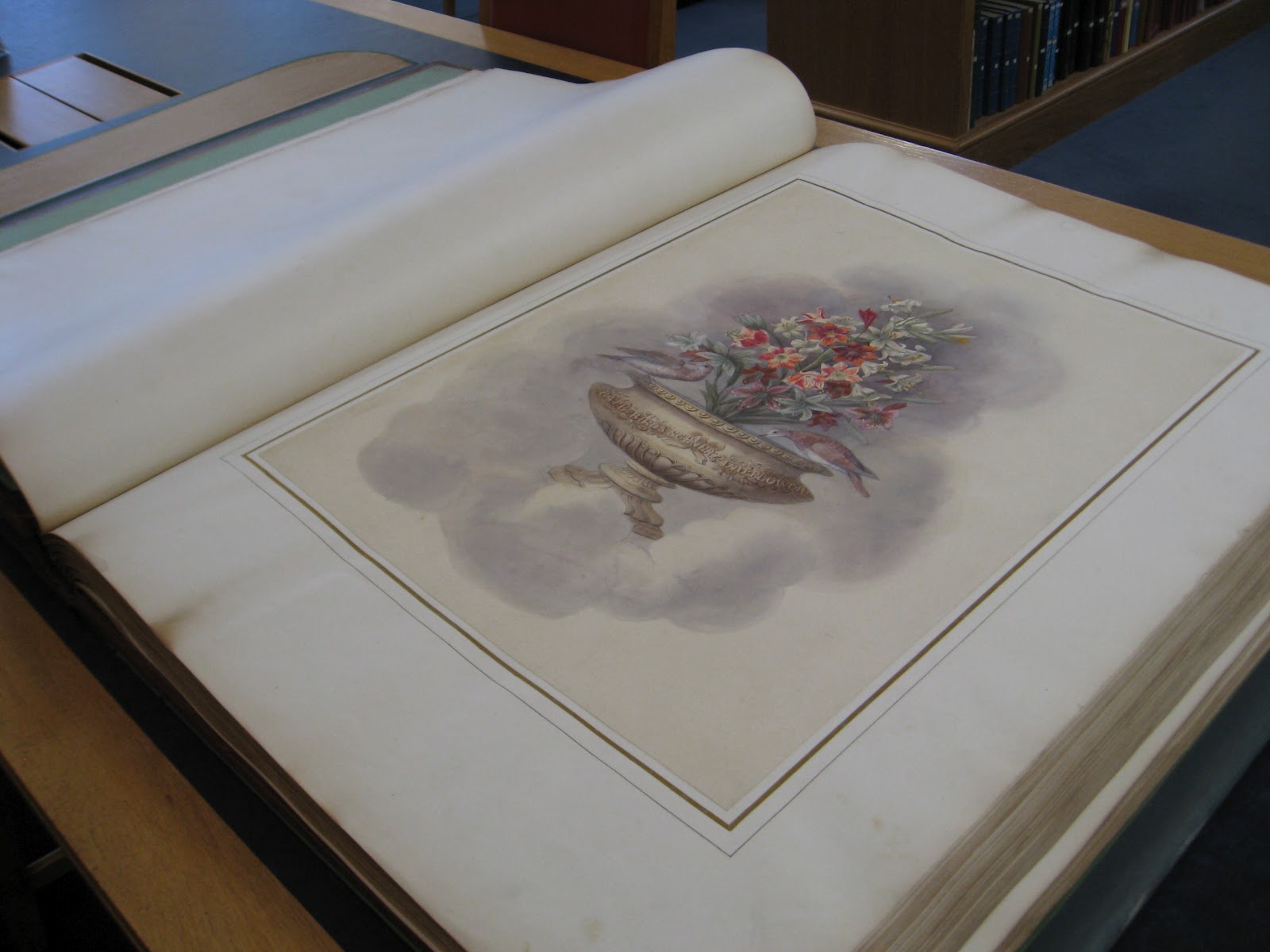
A few weeks ago I finally got to see one of the bound volumes of the Webb Smith paintings which is stored at the University Library because it is absolutely huge (elephant folio size or larger) and we do not have space, or the proper environmental conditions for it in the Balfour Library.   

Cape birds, flowers and scenery was produced between 1839 and 1859. It consists of 56 original water colours mostly signed and dated by Webb Smith.

The pencil was added to give some idea of the scale of the book. It measures around 70cm tall!

Bookplate. Most of the books originally donated to the Museum were moved into the Library at a later date.


The title page itself is very impressive with beautiful colours and detail.

Cape birds, flowers and scenery is written on the urn.


One of my favourites depicts woodpeckers chasing insects on a tree.

Complete painting.

Close up up of the birds.
When you look closely you can see the fine pencil drawings beneath the paint.


This is my absolute favourite because I love kingfishers and it shows the Indian background scenery better - see how the water colours are so vibrant, they leap off the page.


Complete painting.

Close up of the birds.

I think the whites have been done very skillfully and beautifully.


I had a great time photographing these - they certainly attracted a lot of attention in the Manuscripts Reading Room! We are extremely lucky to own such magnificent items.